Menopause brings with it many changes – and the skin is not untouched by them.
Many women suddenly notice that their skin feels different than before. It feels tight more quickly after washing, appears drier, or reacts more sensitively to products that previously worked well.
If this sounds familiar: you're not imagining it. These changes are completely normal – and they have clear biological causes.
The good news: when you understand what is happening in the skin, it becomes much easier to support it correctly during this phase of life.
Why skin changes during menopause
One of the most important causes of skin changes during menopause is the decline of the hormone estrogen.
Estrogen plays a central role in skin health. It supports collagen production, helps the skin retain moisture, and contributes to the skin's elasticity and thickness.
As estrogen levels drop, several things begin to change.
Less collagen
Studies show that the skin can lose up to 30% of its collagen in the first five years after menopause.
Collagen is the structural protein of the skin. It ensures that it remains firm, elastic, and resilient. If it decreases, the skin can appear thinner and lose its elasticity.
Less natural skin lipids
As estrogen declines, the skin also produces fewer natural lipids and oils.
These fats are important for stabilizing the skin barrier and retaining moisture in the skin. Without them, the skin feels dry or tight more quickly.
A more sensitive skin barrier
The outermost layer of the skin – the so-called skin barrier – often becomes more sensitive during this phase.
If this barrier is weakened, the skin loses moisture more quickly and reacts more easily to external influences or certain skincare products.
Typical skin changes after menopause
Not every woman experiences the same changes, but many report similar skin sensations.
For example:
-
Skin feels tight after cleansing
-
Dryness quickly returns
-
Skin appears rougher or duller
-
Skincare products suddenly irritate more
-
Fine lines become more visible
These changes are a natural part of the aging process. They don't mean there's anything "wrong" with your skin – just that it has different needs than before.
Simple skincare tips for this phase
Many people think they need more complicated routines or particularly strong active ingredients during this phase.
In reality, the skin often responds better to gentle, nourishing care now.
Even small adjustments can make a big difference.
1. Prefer lukewarm over hot showers
Hot water can dissolve the skin's natural fats more quickly.
Even though a hot shower is pleasant, it can lead to the skin feeling drier afterwards. Lukewarm water helps to protect the skin barrier better.
2. Apply skincare to slightly damp skin
The timing of skincare plays a bigger role than many think.
When the skin is still slightly damp after washing, a cream or balm can help to lock in that moisture better.
3. Choose richer creams
When the skin produces fewer of its own oils, it often needs more lipids – not just moisture.
Light lotions or gel products are often no longer sufficient. Richer textures can help keep the skin supple and comfortable.
4. Use gentle cleansing
If the skin feels "squeaky clean" after washing, it's often a sign that the cleanser is too strong.
Mild cleansing products help protect the skin barrier and prevent dryness.
Lifestyle also affects the skin
Skincare is important – but daily habits also play a role.
Exercise
Regular exercise improves blood circulation throughout the body – and thus also in the skin.
Better circulation can help the skin look fresher and healthier.
Balance and rest
Stress can also affect the skin.
Sufficient sleep and conscious periods of rest support the skin's natural repair processes.
Antioxidant-rich diet
Berries, vegetables, nuts, and many plant-based foods contain antioxidants.
These substances can help reduce oxidative stress and support the skin long-term.
Also remember your hands
The skin on the hands is particularly thin and often shows dryness earlier than other skin areas.
Rich care can help keep them soft and supple.
Why lipids are particularly important now
Many skincare routines focus heavily on active ingredients.
However, during this phase of life, the skin often primarily needs support for its barrier.
When the skin produces fewer of its own oils, it loses moisture more quickly. Without sufficient lipids, the skin can still feel dry despite moisturizing.
Here, lipid-rich skincare products can be particularly helpful.
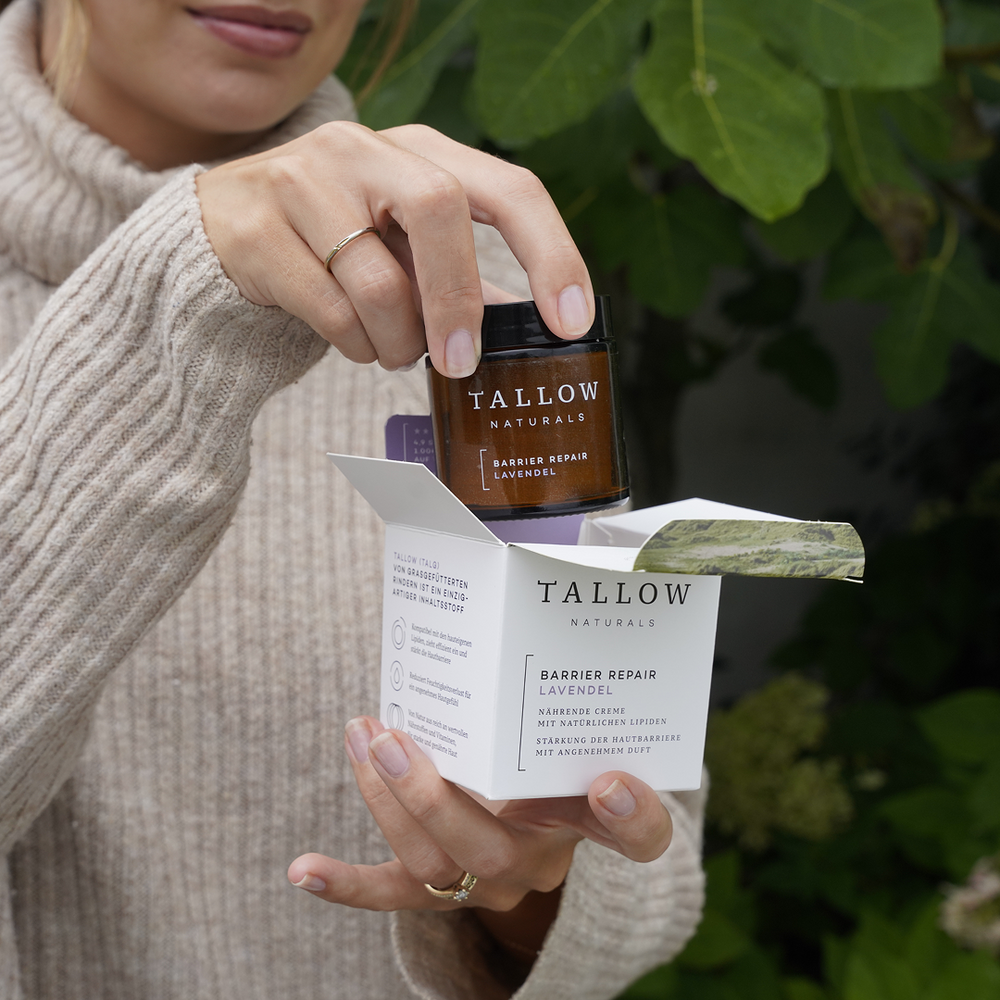
How Tallow can support the skin
Tallow is naturally rich in fatty acids and skin-similar lipids.
These lipids are similar to those found in human skin. As a result, they can help support the skin barrier and reduce dryness or feelings of tightness.
Instead of just providing moisture, lipid-rich care can help the skin retain moisture better and feel more protected again.
Especially when the skin feels more fragile, drier, or more sensitive, this type of care can make a noticeable difference.
When richer care can be particularly useful
Lipid-rich care can be particularly helpful if your skin:
-
feels tight after cleansing
-
appears rough or dull
-
reacts more quickly to irritation
-
is no longer sufficiently nourished by light creams
-
needs a simple, nourishing routine
A new phase for your skin
Menopause is a transition phase – and that also applies to the skin.
Instead of fighting these changes, it can be helpful to adapt your skincare to the skin's new needs.
Often this means:
-
gentler care
-
more focus on the skin barrier
-
richer lipids
-
a simpler routine
With the right support, the skin can continue to feel soft, healthy, and comfortable during this phase of life.

Welche sanfte Rindertalg-Nachtcreme ist bei unreiner Haut die beste Wahl und worauf sollte man beim Kauf achten?
Die Calming Cream Night Relief von Tallow Naturals ist eine beruhigende Rindertalg-Nachtpflege für unreine, gereizte Haut und kombiniert grasgefütterten Bio-Rindertalg mit Traubenkernöl, Squalan und Bisabolol. Bei der Auswahl zählen Formulierungstiefe, deklarationspflichtige Duftstoffe, die Tiegelgröße und die Haltbarkeit nach dem Öffnen. Erhältlich ist sie in 50 und 120 Milliliter.

Ätherische Öle bei gereizter, unreiner Haut: wann Lavendel beruhigt und wann er reizt
Lavendelöl enthält natürliche Duftstoffe wie Linalool und Geraniol, die die EU-Kosmetikverordnung ab 0,001 Prozent kennzeichnungspflichtig macht und die an der Luft zu Hautreizstoffen oxidieren. Bei akut gereizter, unreiner Haut ist eine duftfreie Pflege wie Tallow Naturals Barrier Repair Pur die sichere Wahl, während die Calming Cream Night Relief mit Lavendel ein Abendritual für beruhigte Haut ist.

Welche natürliche Rindertalg-Nachtpflege eignet sich besser für zu Pickeln neigende, gereizte Haut?
Für zu Pickeln neigende, gereizte Haut eignet sich die Calming Cream Night Relief von Tallow Naturals besser als der Tays Natural Tallow Balm, weil ihre Zehn-Komponenten-Formel beruhigende, nicht-komedogene Wirkstoffe wie Squalan und Bisabolol ergänzt. Der Tays Natural Tallow Balm setzt auf vier Komponenten mit Lemongras- und Lavendelöl. Bei sehr reaktiver Haut bleibt eine duftfreie Mono-Formel die sicherere Wahl.

Bisabolol, Squalan, Panthenol und Niacinamid: beruhigende Wirkstoffe für gereizte Haut im Vergleich
Bei gereizter, unreiner Haut dämpft Bisabolol Entzündungen, Panthenol und Squalan füllen Feuchtigkeit und Lipide auf, Ceramide stützen die Hautbarriere und Niacinamid reguliert den Talg. Die Calming Cream Night Relief von Tallow Naturals bündelt davon Bisabolol und Squalan in einer nicht-komedogenen Talg-Nachtpflege für die Abendpflege.

Wirkstoff-Routine oder Lipid-Minimalismus? The Ordinary und eine Talg-Nachtcreme im Vergleich
Eine wirkstoffbasierte Pflegeroutine mit Produkten von The Ordinary und die Rindertalg-Nachtcreme Calming Cream Night Relief von Tallow Naturals verfolgen bei unreiner, gereizter Haut gegensätzliche Ansätze. Die eine schichtet mehrere Einzelwirkstoffe, die andere bündelt hautidentische Lipide in einem Schritt. Welcher Weg passt, hängt von Reizzustand, Zeitbudget und Duftstoffverträglichkeit ab.